



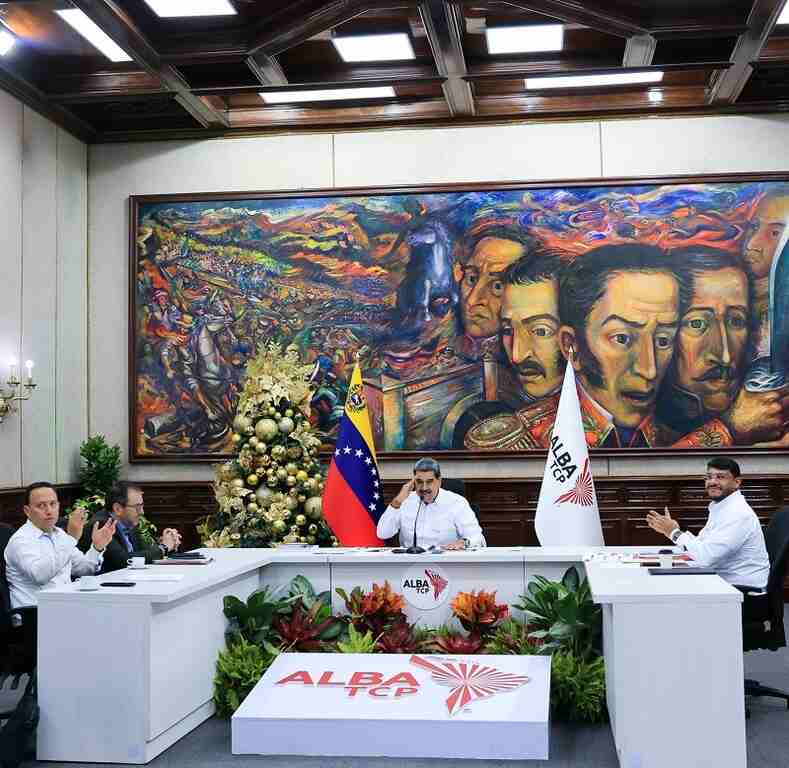
The will of the heads of state and government of ALBA-TCP to advance and overcome threats and adversity was evident at the recently concluded 25th Summit of the Latin American and Caribbean integration bloc.
This meeting, held virtually with its nine member countries, was inspired by the example of revolutionary dignity and unwavering defense of sovereignty of the historic leader of the Cuban Revolution, Fidel Castro, and in the context of the centennial of his birth to be celebrated next year.
It was also held on the eve of the Bicentennial of the Amphictyonic Congress of Panama and amid growing threats to peace and stability in Latin America and the Caribbean.
The 13-point final declaration of the XXV Summit of the Bolivarian Alliance for the Peoples of Our America-Peoples’ Trade Treaty (ALBA-TCP) reaffirmed the unwavering commitment to further deepening the Bolivarian doctrine, thought, and action.
The summit deemed it “incompatible with any form of hegemony, domination, or imperial tutelage,” a fundamental pillar that inspired Fidel Castro and Hugo Chávez to found the Bolivarian Alliance.
The ALBA declaration condemned in the strongest terms the declared purpose of the recently published United States National Security Strategy, aimed at reaffirming the “obsolete and historically defeated Monroe Doctrine.”
It also censured the act of piracy committed by the United States government in attacking and seizing a Venezuelan oil tanker in the Caribbean Sea, an act it considered a violation of international law and an attack on the sovereignty of the Bolivarian Republic.
The final declaration congratulated the Venezuelan people for demonstrating, once again, profound resilience in the face of adversity and for courageously and conscientiously defending their dignity and right to their own destiny.
The ALBA-TCP declaration demanded the exclusion of Cuba from the “arbitrary and spurious list of countries that supposedly sponsor terrorism”; and highlighted the achievements of Nicaragua’s Government of National Reconciliation in building a sovereign economy, in a country that is increasingly free, Christian, and socialist.
The ALBA-TCP meeting also demanded the immediate cessation of all military threats against any country in Our America and reiterated the full validity of the Proclamation of Latin America and the Caribbean as a Zone of Peace, adopted in January 2014 in Havana, Cuba.
It reaffirmed its commitment to defending the rights of migrants and demanded compliance with protocols for safe, orderly, and respectful repatriation with human dignity.
The final declaration of ALBA-TCP also acknowledged the progress of the AgroAlba and AlbaAzul programs, aimed at increasing levels of food and production sovereignty; celebrated the start of operations of the ALBA Ship; and approved the 2026 Action Plan, which is aligned with the objectives set forth in the 2030 Strategic Agenda.
One of the most significant events was the announcement of the creation of an International Energy and Electricity Mission, comprised of ALBA-TCP member states and other countries, with “the intention of supporting the sister Republic of Cuba in the complete restoration of electricity in the country.”
President Nicolás Maduro commented that he had given instructions to increase “everything we are doing, two or three times over” and assured, “we will emerge better, stronger, more aware, and more victorious than ever.”
The Bolivarian leader asserted that 2025 has been a good year for ALBA-TCP, characterized by close coordination, joint work, planning, and action.
Maduro highlighted the revitalization of trade through the ALBA Ship, “the first one to make the round trip,” which has already transported more than 20,000 tons of various commercial and solidarity aid items, including aid to the Cuban people following Hurricane Melissa in October.
He declared that, 21 years after the founding of the Bolivarian Alliance, it remains the great project of unity, emancipation, and multidimensional liberation for our peoples in times of tremendous challenges.
For his part, Cuban President Miguel Díaz-Canel affirmed that the Latin American and Caribbean integration bloc will continue to be an essential space “of solidarity, dignity, and resistance” in the face of destabilizing campaigns, pressure tactics, and all forms of aggression.
The Cuban leader emphasized that “we will continue fighting for a common goal, which is the unity, peace, and sovereignty of our peoples,” always faithful to the ideals of Bolívar, Martí, Fidel, and Chávez.
From Nicaragua, co-president Daniel Ortega denounced the recent U.S. hijacking of an oil tanker and its crew as a robbery, which Venezuelan authorities considered the “inauguration of a new era of criminal naval piracy in the Caribbean Sea.”
Meanwhile, the Minister of Foreign Affairs, Foreign Trade, Foreign Investment, and Diaspora Affairs of Saint Vincent and the Grenadines, Dwight Fitzgerald, stated that ALBA-TCP has demonstrated to the world that it has much to offer in terms of environmental respect, racial and ethnic harmony, economic cooperation, and tolerance.
This 25th Summit of the Bolivarian Alliance announced the activation of new permanent mechanisms for social, political, and cultural cooperation to strengthen the bloc’s cohesion. These included the creation of a community training circuit for the exchange of knowledge and leadership, and the formal establishment of a task force for coordinated disaster response, among other initiatives.
Nos reservamos el derecho de no publicar los comentario que incumplan con las normas de este sitio