



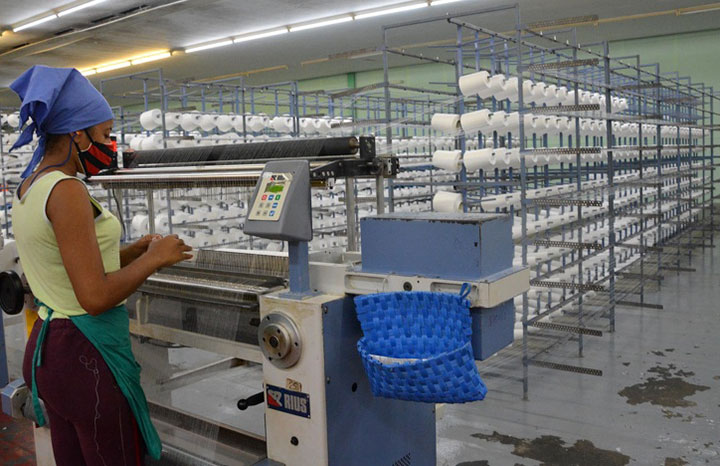
In a commitment to technological sovereignty, the Desembarco del Granma Textile Company in the Cuban central province of Villa Clara became the first factory in Cuba to install a high-temperature industrial heat pump system.
This system reduces dependence on fossil fuels, saves foreign currency, and mitigates environmental impact. Innovation with a Double Benefit The system, comprised of six high-efficiency units, operates on an intelligent dual-use principle.
On one hand, it extracts heat from the ambient air to heat water to over 90 degrees Celsius, a vital process for bleaching the yarn and surgical gauze fabrics produced there.
Simultaneously, it generates cool air used to air-condition the finishing room, improving working conditions.
"This technology demonstrates that it is viable to replace fossil fuels even in industrial processes that demand intense heat," Manuel Alejandro Rubio Rodríguez, director of the Center for Energy Studies and Environmental Technologies (CETA) at the Marta Abreu Central University of Las Villas (UCLV), told the Cuban News Agency in an exclusive interview.
This technological leap, he said, is not a foreign adaptation, but a conceptual engineering solution developed specifically for the needs and energy context of Cuban industry.
Integration into the production process also required the installation of hydraulic circulation pumps and a pressurized thermal storage tank, which ensure a constant and efficient supply of hot water to the bleaching line.
This precise design prevents heat from being wasted and reuses it within the manufacturing cycle itself. The implementation of this system directly replaces the burning of fuel oil, a costly and polluting fossil fuel, for water heating.
Furthermore, the cool air produced eliminates the need for the electricity consumption of the fans in the old air conditioning system, which was out of service, the official stated.
This double replacement represents a paradigm shift in industrial energy management within the country, demonstrating a clear path toward efficiency.
A strategic alliance that materializes savings This project is the result of exemplary collaboration between academia, the government, and international cooperation.
The conceptual engineering and scientific development were carried out by CETA, a research center with more than three decades of experience in energy efficiency.
The execution and institutional support were led by the National Office for the Control of the Rational Use of Energy (ONURE).
Financial and technical support came from the United Nations Industrial Development Organization and the European Union.
María de los Ángeles García Hernández, technical director of the textile company, emphasized that this convergence of efforts was fundamental. "The integration of all these stakeholders allowed us to materialize a solution tailored to our industry." "
For us, energy efficiency is not an expense, it is a sustainability and cost reduction strategy that positively impacts economic results," she explained.
Her testimony underscores the company's commitment to modern and responsible management.The economic benefits of this alliance, she noted, are concrete and measurable.
Implementation generates estimated net savings of 579,000 pesos annually for the company and has improved its competitiveness.
For the national economy, the project represents foreign exchange savings of $39,800 per year by reducing the need to import fuel oil.
Furthermore, the investment recovery period is only 3.76 years, an indicator of high profitability.
These figures translate the value of applied innovation into tangible results. A beacon of sovereignty in the face of adversity and the blockade The project consolidates Villa Clara's leadership in the national energy transition.
Armando Hernández Pedroso, director of the National Office for the Rational Use of Energy (ONURE) in the province, contextualized the achievement:
"This initiative is part of the efforts of a province that now exceeds 5,000 megawatts peak of installed capacity in renewable sources." "It is a living example of how smart energy management, supported by science, can transform industry."
The textile factory is part of a provincial learning network that, since 2021, has been implementing energy management systems under the international standard ISO 50001.
For citizens, these technical solutions represent a ray of practical hope in the face of everyday challenges. “Projects like this are vital.
They show us that, with ingenuity and our own science, we can confront the blockade imposed by the United States and the energy deficit that so greatly affects our daily lives.
Every kilowatt saved or generated cleanly is a step toward greater independence,” commented Roberto Fernández Linares, a resident of the Escambray neighborhood in Santa Clara.
His statement reflects the direct connection between industrial innovation and the well-being of the community.
The Desembarco del Granma Textile Company, founded in 1979, is a symbol of national industry.
As the only complete-cycle facility in Cuba for the production of sewing thread and surgical gauze with crocheted fabric, its history is linked to the development of the country.
Today, this innovation with a heat pump reaffirms its pioneering spirit. It demonstrates, in a tangible way, that the strategic union between the university and the productive sector is the safest way to build an efficient, sovereign and sustainable industry, capable of overcoming external obstacles and facing the future with its own resources.
The energy-saving textile heat pump that defies US blockade
Nos reservamos el derecho de no publicar los comentario que incumplan con las normas de este sitio