



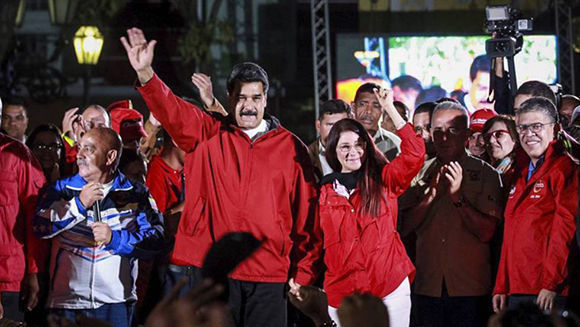
HAVANA, Cuba, January 9 (ACN) The kidnapping of the constitutional president of the Bolivarian Republic of Venezuela, Nicolás Maduro Moros, and the First Lady, Cilia Flores, by the United States government is considered a direct attack against sovereignty and the right of people to self-determination, the Granma newspaper reported.
According to Freider Santana Lescaille, vice president of the International Law Society and First Vice-Rector of the University of Oriente in Cuba, this act violated the principles of sovereign equality and non-intervention, enshrined in the Charter of the United Nations, as well as General Assembly Resolution 2625, which prohibits interference in the internal affairs of other states.
Article 2(1) of the UN Charter enshrines the sovereign equality of states, while Article 2(7) prohibits intervention in internal affairs.
General Assembly Resolution 2625 (XXV), entitled “Declaration on Principles of International Law concerning Friendly Relations and Cooperation among States,” reaffirms that no State may intervene directly or indirectly in the affairs of another.
Legal experts pointed out that the action against the highest Venezuelan authority constitutes an extreme form of intervention, as it violates the territorial integrity and political independence of that country, in contravention of international law.
The right to self-determination of peoples, enshrined in Article 1 of the International Covenant on Civil and Political Rights (1966) and Article 1 of the International Covenant on Economic, Social and Cultural Rights (1966), establishes that all peoples may freely determine their political status and development without external interference.
The International Court of Justice, in its 2004 Advisory Opinion on the “Legality of the Construction of a Wall in the Occupied Palestinian Territory” (paragraph 88), reaffirmed that self-determination is an essential principle of contemporary international law.
In the case “Matters Concerning Military and Paramilitary Activities in and Against Nicaragua” (Nicaragua v. United States, 1986 Judgment, paragraphs 202 and 292), the ICJ condemned Washington’s use of force and covert actions, considering them to be violations of the principle of non-intervention and the Nicaraguan people’s right to self-determination.
By analogy, the kidnapping of President Maduro and First Lady Flores represents an even more serious violation, as it seeks to create a power vacuum and social chaos by imposing an external administration contrary to the popular will.
Experts emphasized that any change in the Venezuelan government structure must stem from legitimate internal processes, in accordance with the principles of sovereignty and self-determination, and not from international coercion.
In a recent interview with The New York Times, Donald Trump stated that "I don't need international law" and maintained that "only my morals limit me," justifying the United States' ability to act according to its own will on the global stage.
This statement generated criticism in various international forums for contradicting the principles of the Charter of the United Nations. Defending Venezuela's sovereignty and self-determination is considered essential for preserving international order, not the imposition of force.
Cuba, Venezuela, and countries that uphold international law urge that the events be denounced in all multilateral forums and demand the immediate restoration of legality with the return of President Maduro and his wife to Venezuela.
Kidnapping of the Venezuelan president violates international law
Nos reservamos el derecho de no publicar los comentario que incumplan con las normas de este sitio