



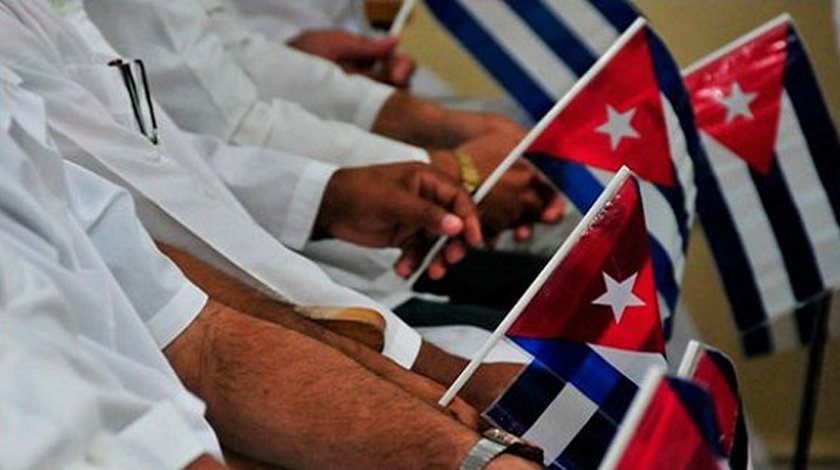
HAVANA, Cuba, May 24 (ACN) More than eight million lives have been saved and some 2.46 billion people have received the services of Cuban medical collaboration since May 23, 1963, when Cuba sent the first health brigade to the Republic of Algeria.
On the 58th anniversary of that event, Dr. Jorge Delgado Bustillo, director of the Central Unit for Medical Cooperation, told the Cuban News Agency in an exclusive interview that during all these years the principles of voluntariness, humanism and sharing what we have and not what we have to spare have prevailed.
He recalled that when the Revolution triumphed, about half of the doctors in the country emigrated to the United States and other countries, and even so, help was offered to Algeria, which had achieved its independence from French colonialism.
Likewise, in the 1960s, collaboration was established with several African states and by the 1970s it had increased to 450,000 health professionals, who in different generations have provided medical assistance in more than 140 countries.
He also mentioned that they are currently working in 63 countries with 28,705 collaborators, and the Venezuelan Special Mission stands out with more than 20,000 collaborators.
He added that 37 percent of the professionals are doctors and the rest are nurses, health technologists, administrative and auxiliary personnel.
Among the statistics offered by the executive, who has 23 years of experience in medical collaboration, he highlighted the more than 14 million surgeries performed and the assistance to the birth of 4,570,000 children.
He also acknowledged the creation of the "Henry Reeve" International Contingent of Doctors Specialized in Situations of Disasters and Serious Epidemics, on September 19, 2005 by Commander in Chief Fidel Castro, in the wake of Hurricane Katrina in the southern United States.
The aid was not accepted, but the medical force was formed and on October 8 of that year more than 680 collaborators went to Guatemala to help victims of floods.
Six days later, the first collaborators left for Pakistan, for a total of 2,564, who were distributed in 32 field hospitals in order to help the victims of a powerful earthquake.
Another significant mission was Haiti, after the earthquake of January 12, 2010 and 10 months later when the cholera outbreak occurred; and the presence in Sierra Leone, Guinea Conakry and Liberia during the Ebola epidemic also deserved worldwide recognition.
Delgado Bustillo, who was an advisor to the Pan American Health Organization in several countries, head of medical missions and founder of the Contingent, praised the work of the aid workers in confronting COVID-19 with the formation of 57 brigades that reached 40 countries.
The Henry Reeve Contingent has been nominated for the Nobel Peace Prize (2021) from all over the world for its selfless and humanistic performance, and for this reason it received the 2020 Excelencias Award, given by the Excelencias Group every year during the Madrid International Tourism Fair.
To commemorate the 58th anniversary, outstanding collaborators were recognized across the country and the Ministry of Public Health called on social media users to join today's tweeting to share the experiences of that "army of white coats" in these years of Cuban solidarity.
Nos reservamos el derecho de no publicar los comentario que incumplan con las normas de este sitio