



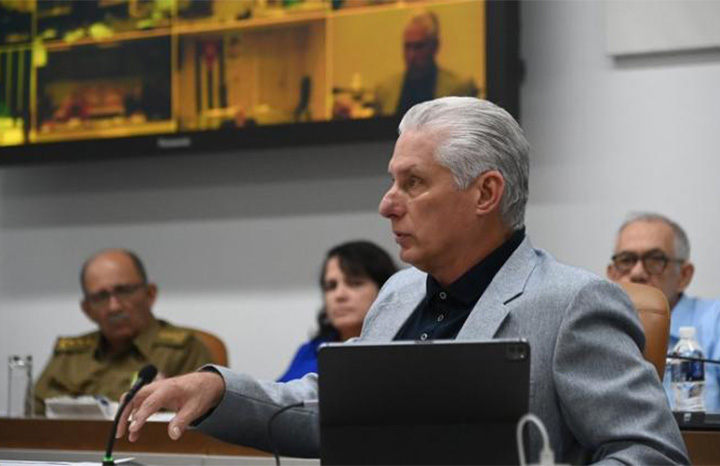
Unity is forged through participation and seeking consensus; because unity is not an abstract concept, and it is “the guarantee that Cuba will continue to be free, independent, and sovereign,” stated the First Secretary of the Central Committee of the Communist Party and President of the Republic, Miguel Díaz-Canel Bermúdez, during his address this Saturday at the 11th Plenum of the Central Committee.
His remarks were prompted by the debate that arose from the presentation of the Report on compliance with the agreements adopted since the 8th Plenum. The Party Congress, held in April 2021, and the Political Bureau’s accountability report to the 11th Plenum, are two agenda items that encompass strategic issues for the nation’s economic and social development.
The Cuban president emphasized the need to continue intensifying “the ideological, cultural, and communications battle, defending the truth about Cuba against manipulation and disinformation,” two elements that the enemy has embraced with “very perverse practices.”
In this regard, he referred to the harmful content against Cuba that floods social media and that must be confronted more proactively, demonstrating what is being done in the country, because with the economic and media war imposed on us, “here, every day of the Revolution is a victory, because we are facing the most powerful enemy, and we are facing it with tremendous dignity.”
The amount of pressure and difficulties imposed on us by the intensified economic, commercial, and financial blockade imposed by the United States government, and by media manipulation, is extremely high, he emphasized.
“Only a heroic people who defend a Revolution, who have the example of that Revolution’s history, are capable of enduring what we have been experiencing all these years,” the president stressed, insisting on the importance of this being accompanied by “a different style of work within the Party.”
A style of work, he insisted, that must be characterized by a direct fight against bureaucracy, pretense, and double standards, that promotes participatory collective leadership, and where cadres are increasingly better prepared, “because the problems are very complex and we cannot be improvising.”
Diaz-Canel referred to the essential need to promote a work style that fosters open debate, constructive criticism — including self-criticism — and the constant practice of correcting mistakes, because “the Revolution has never been afraid of making mistakes; the key is that when we make mistakes, we acknowledge them and correct them.”
In his remarks, Díaz-Canel also called for “confronting corruption more decisively and effectively,” an area in which, as noted in the Accountability Report, he acknowledged that a series of steps have been taken. “This demonstrates that there is an intensity in the fight, but we must continue, and above all, learn from each event.”
The First Secretary of the Central Committee of the Communist Party also spoke about the Revolution’s capacity to convene, organize, and overcome the most diverse obstacles, for which history has shown that the participation of all the people is fundamental.
The Cuban leader commented on the complex epidemiological situation the country is experiencing and how it has been addressed, based on the fact that the population, and indeed the country as a whole, has enormous confidence in our Health System due to its historical performance.
Regarding what has happened in recent months as a result of the Chikungunya epidemic, the president considered that because the initial focus was on responding to dengue, the arrival of the new virus in Cuba allowed the disease to spread more rapidly throughout the country.
And while it is true that there are currently very objective limitations in the National Health System, he acknowledged that there are also subjective problems with organization, and with the monitoring and control of certain situations.
This objective situation affecting the sector, he said, means that we must act more proactively and have faster alert systems, since the population is more vulnerable to any type of disease that may arise.
Because the truth is, he said, that “life shows us that we know what needs to be done at every moment,” since as soon as the alerts began regarding the growing number of cases, action was taken quickly in Matanzas, which in just a few weeks returned to a near-normal situation with the epidemic.
Furthermore, he referred to the initial lack of targeted and adulticide treatments, as well as fumigation, due to a lack of resources at certain times. However, when the resources were finally allocated, the personnel to carry them out were not available. Hence his insistence on greater popular participation in these types of actions, as there was a positive response when medical students and young people from other sectors were called upon to participate in fumigation.
“This is how we are going to solve problems,” he emphasized, adding that this practice should be applied to “all scenarios where we face problems and adversities, which we know are mostly caused by the blockade, but in which we also have to be self-critical.”
Referring specifically to the work that the Party must carry out under the current conditions, he insisted that we cannot allow “bureaucracy, formalism, and inertia to continue hindering the will of the Party and the needs of our population.”
He also commented on the work that must be done to strengthen control mechanisms and ensure that accountability is thorough and systematic in all areas of our society.
What we discuss in this plenary session, he said, would be meaningless if the Party does not demand of itself a different way of operating in these times, which implies that we must constantly be in contact with the population and give them a voice in everything we plan and do.
Specifically regarding the process of analyzing the Government Program to correct distortions and revitalize the economy, the Cuban president emphasized the priority of continuing to work so that the population is familiar with it, participates in the debate, and strengthens its content with their input.
“We must be closer to the real problems of the people, be more demanding of our leaders, and more transparent in our relationship with our society,” he stated.
“And once again, this plenary session reaffirms that to achieve everything we have set out to do, we must continue to defend unity and have a clear understanding of how the party’s grassroots members and organizations should act in neighborhoods, workplaces, and schools, to be active listeners, mobilizers, and personal role models.”
And if we want to move things forward, he said, the first thing we must achieve is that “the Party’s grassroots organizations in every location are strong and demanding, and that the membership is at the forefront of all tasks; and we don’t always achieve that.”
None of these issues are new, he acknowledged; they have been discussed within the Party. The key is that each one must be viewed within the context of the current situation, and we must be able to make progress on them as they are discussed.
This way of acting, he added, is closely linked to how the Party operates and is capable of leading, driving, and helping everything we have set out to achieve, both in the ideological and economic battles, to move forward, because this is what gives the people confidence in their institutions.
If our institutions do not deliver results, nor demonstrate a genuine sensitivity to the population’s problems, if they fail to fulfill their plans, if they do not address the problems for which they were designed, then the people cannot have confidence in the institutions.
Finally, he mentioned key issues that must remain central to the Party’s work, such as strengthening political unity and the Organization’s role in guiding the country’s processes, prioritizing the ideological, economic, and communication battles that we are called to wage every day.
He also emphasized the need to continue prioritizing the containment of ideological subversion, analyzing the new tactics the enemy employs against us.
He also specifically addressed the need to focus on youth, stating that “young people in our society are not only guaranteed the benefits of the public policies we implement, but are also active participants in the revolutionary process.”
There will be no economic recovery, nor a strong ideology, if we do not take young people into account, if we do not guarantee their comprehensive development, if we do not ensure they engage in both study and work, and contribute to society, “so that they feel a part of it and see their future as possible in socialist Cuba.”
In the final minutes of his speech, he presented a set of proposals and guidelines for party work, which were approved by the 11th Plenum of the Central Committee.
NO ISSUE IS EXCLUSIVE TO THE PARTY’S WORK
The necessary recovery of the National Electrical System and the efforts being made to achieve this priority objective, as well as the complex epidemiological situation facing Cuba, were topics of analysis as part of the Political Bureau’s accountability report to the 11th Plenum.
Food production, still far from meeting the population’s needs, was also central to the debate led by Political Bureau member and Secretary of Organization, Roberto Morales Ojeda, who presented the aforementioned report.
This document contains a detailed account of the work done amidst the complex scenario that characterizes the current national context, in which multiple political, ideological, and social factors converge.
The life of the country and the daily lives of its citizens, Morales Ojeda said, have been marked by insufficient foreign exchange earnings, fuel shortages, difficulties in ensuring water supply, limitations in national production, particularly of food, shortages of essential products, transportation problems, the complex epidemiological situation, and high prices.
“If there is more food production, that will also have an impact on another major concern, which is prices, and the purchasing power of our own salaries will increase,” added the Secretary of Organization of the Central Committee.
Later, he reasoned that while there is some encouraging data regarding food production, “it is far from resolving the needs, far from solving the problem of territorial self-sufficiency, and far from being able to replace the import of many products that are currently part of the basic food basket.”
In his presentation, he also referred to the actions taken by the National Defense Council to address the impacts of Hurricane Melissa, while specifying the topics analyzed by the Political Bureau, including those related to the review of the Government Program to correct distortions and revitalize the economy.
Regarding the review of the agreements for the period, he explained that there are ten, two of which have already been fulfilled, and the rest are in progress.
As part of the debate generated by both topics, the Minister of Energy and Mines, Vicente de la O Levy, a guest at the 11th Plenary Session, commented on the numerous actions that have been underway to advance the country’s Electroenergy Stabilization Program, in which the Political Bureau has been involved from the outset.
This year, he affirmed, progress has been made on some of the Program’s objectives, such as the installation of photovoltaic solar parks and the recovery of distributed generation.
The last few days, he recalled, have been marked by extremely high levels of power outages, primarily due to the loss of generation capacity resulting from fuel shortages and a lack of installed technology.
Regarding the complex epidemiological situation our country has faced since the second half of the year, mainly due to the increase in diseases transmitted by the Aedes aegypti mosquito, the member of the Central Committee and Minister of Public Health, Dr. José Angel Portal Miranda, explained that the complexity stems not only from the magnitude of the epidemic but also from its direct impact on the daily lives of our population.
The circulation of several arboviruses, especially dengue and chikungunya, he noted, has become a challenge for the National Health System, due, among other factors, to the intensity of transmission, accumulated vulnerability, and the coexistence of various risk factors in our population. This reality, he acknowledged, has increased the burden on healthcare services and the complexity of the clinical and epidemiological management of both viruses.
After discussing the behavior of the chikungunya epidemic in our region, he commented that the introduction of the virus into Cuba was a real risk, primarily associated with international and regional travel, and not the result of an isolated incident. Its spread throughout the country has presented an extraordinary challenge for the National Health System, not only due to the volume of cases but also because of the conditions under which the epidemic has had to be confronted.
He explained that in certain areas, problems have arisen in the organization of vector control efforts, leading to limited effectiveness of the treatments applied, in addition to persistent objective resource shortages, as well as limitations in fumigation equipment, insecticides, medications, and laboratory reagents, among other things.
Added to this is a complex environmental scenario, characterized by difficulties in water supply, sanitation problems, waste accumulation, and unfavorable hygiene and sanitation conditions in numerous communities.
Even though we are not satisfied with what we have been able to do, he noted, in the current context the National Health System has responded, among other measures, by reorganizing and creating new service capacities; strengthening Primary Health Care; increasing the screening of febrile cases; and deploying intensive vector control actions in higher-risk areas, in accordance with available resources.
Despite the dissatisfaction with what has not been achieved, the Minister of Public Health acknowledged the effort made by the sector’s workers, who have sustained a response under extremely difficult conditions, with long hours and limited resources, but with admirable dedication and responsibility.
Also as part of the debate, Teresa Amarelle Bué, member of the Political Bureau and secretary of the Federation of Cuban Women (FMC), mentioned how the recommendations made by the Eighth Congress of the Communist Party regarding the organization’s functioning, especially at the grassroots level, have been followed up.
She also referred to the need to address violence against women in communities with greater priority, because even though the country has robust laws to combat it, progress is not as rapid as it should be.
She stated that the first assessment of vulnerabilities must be carried out at the community level to truly reverse existing problems. In this regard, she acknowledged the role women play in society, engaged in the country’s most important tasks.
On the other hand, regarding the work being done to achieve the fulfillment of the various food production programs, Félix Duarte Ortega, national president of the National Association of Small Farmers (ANAP) and member of the Central Committee, said that what has been done is “far from satisfying the needs of our people.”
Among the work priorities that have been proposed, he highlighted monitoring the contracting of agricultural production; providing differentiated support to the 262 cooperatives that are experiencing operational problems; and addressing the non-payment of farmers.
Other interventions were related to addressing social policies; the comprehensive education of young people in schools; the need to strengthen the economy; the promotion of institutional development; and the need to broaden awareness among our population of the real impacts of the U.S. government’s blockade on our society.
Nos reservamos el derecho de no publicar los comentario que incumplan con las normas de este sitio