



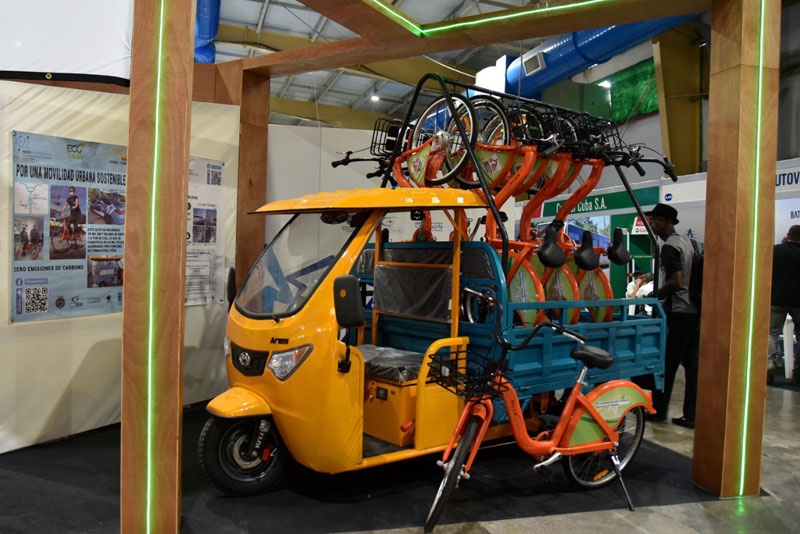
Sustainable mobility is increasingly demonstrating its importance in Cuba, a country that faces problems in public transportation and in which the technical availability of vehicles and fuel is hindered, among other factors, by the economic, commercial and financial blockade of the U.S. government.
Therefore, the nation needs its own strategies and programs that, with international collaboration, make the change of paradigm in transportation in the main cities a reality.
Havana has been the subject since 2019 of the Neomovility project with advice from the United Nations Development Program, which seeks a low-carbon system with the use of electric vehicles and the use of non-polluting forms such as bicycles.
According to the Economic Commission for Latin America and the Caribbean, it is an infrastructure that generates lower emissions compared to the possible infrastructure alternatives for the provision of a specific transportation service under particular conditions.
Reinier Campos Pompa, head of Development of the General Directorate of Provincial Transportation of Havana (DGTPH by its Spanish acronym), the agency in charge of implementing Neomovilidad, has stated that the initiative includes the development of a regulatory framework and research on the behavior of transportation in the capital, which support the interventions.
In addition to this, it includes small specific actions to redistribute the use of roads, allocate more space to sidewalks, walkways and bicycle lanes promoting pedestrian or non-motorized mobility.
It is expected that Neomovilidad, although not the definitive solution, will reduce the problems associated with the excessive use of fossil fuels, contribute to reduce dependence on fossil fuel imports, and cover the growing demand for passenger transportation services.
According to Campos Pompa, the trial operations of the program will benefit those who use local urban services on short routes, since the objective is to connect them with main bus routes and link them to important centers in the community such as schools and hospitals.
It should not be forgotten that the tricycles have a range of up to 120 kilometers, so they can work for five or six hours. With this in mind, it was decided to stagger the schedules and the number of vehicles so that they operate until 7 p.m., he said.
The public bicycle system is another sustainable mobility project that will finally materialize before late 2022. Its purpose is to ease transportation, mainly for students and professors of the Technological University of Havana, a center located in Marianao and difficult to access from other parts of the city.
The head of Development of the General Directorate of Provincial Transportation explained that the program includes a central station at the university and six bicycle stations distributed in Boyeros, which will connect the bicycle lanes along which 300 bicycles will travel.
Contrary to what one might think, the use of bicycles in big cities is a growing practice. For example, in Latin America, capitals such as Bogota (Colombia), Santiago de Chile (Chile) and Mexico City (Mexico) encourage its massive use with the creation of road infrastructure.
Cuba thus recognizes one of the United Nations goals for 2030, which aims to provide access to safe, affordable, accessible and sustainable transport systems for all and to improve road safety.
Nos reservamos el derecho de no publicar los comentario que incumplan con las normas de este sitio