



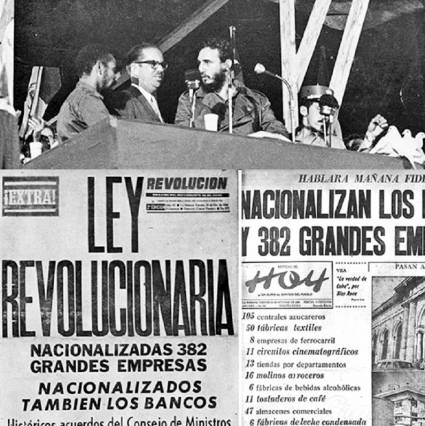
As instructed by Commander Ernesto Che Guevara, president of the National Bank of Cuba, Act No. 891 on the Nationalization of the Banks was drafted and approved by the Council of Ministers on October 13, 1960, "with the objective of definitively liquidating the economic power of the privileged interests that conspired against the people" and to ensuring that only the State could engage in banking operations as the only way to exercise national economic sovereignty.
The text of the legislation included a historical assessment of the role of U.S. banks: "One of the most effective instruments of imperialist interference in our historical development has been represented by the operation of U.S. commercial banks, which have served as a financial vehicle to facilitate the monopolistic actions of U.S. companies in Cuba and for the massive invasion of the country by imperialist capital (...)".
In October 1960, U.S. and private banks linked to Yankee interests were operating in Cuba which during the pre-revolutionary period had played a key role in corrupting the state apparatus, stealing the national wealth and tampering with tax and tariff collection.
These banks, together with the Cuban lackeys that made up the neocolonial power structure, became a major bastion for the first aggressive plans and actions orchestrated in Washington against the Island.
Act 891 affected five parastatal credit institutions and 44 private banks, six of them foreign, and declared the Banco Nacional de Cuba as the sole continuator of all those private institutions. Likewise, Decree-Law No. 382 applied the same provision to large bourgeoisie-owned companies, including 105 sugar mills and 37 banks running 300 offices across Cuba. The legislation also established the forced expropriation of 382 companies related to sugar, food and alcoholic beverage production, construction and transportation, among others.
The nationalization process dealt a decisive blow to the domestic circles allied to anti-Cuban imperialist plans designed to reinstate the neocolonial republic and cleared the way for the profound and definitive economic and social changes of the Revolution.
Media campaigns have long portrayed these first expropriations as disproportionate and unjustified acts against U.S. interests and the first cause that the two nations broke up relations, since Washington had to react to the violation of its interests.
However, on March 16 that year, more than six months before the enactment of those laws, President Dwight D. Eisenhower had approved the first "Covert Action Program against the Castro Regime", which included intelligence operations, economic blockade, international isolation, terrorist plans, subversion, propaganda and, ultimately, a direct attack to topple the Cuban Revolution, and revealed the use of U.S. businessmen with companies in Cuba to serve as cover for and fund CIA activities to support the internal counterrevolution.
Even before its approval, Eisenhower's plan was already in motion through acts of sabotage in Cuban cities, burning of sugarcane fields, uprisings and terrorist attacks such as the March 4 blowing-up of La Coubre, a steamship carrying weapons and ammunition that Cuba had bought in Belgium.
Sixty-two years have passed since those measures were taken, but beyond their important legal significance, history has shown that they were also steps to protect Cuba from the most comprehensive economic war ever waged by U.S. imperialism against a country.
Nationalization of U.S. interests in defense of Cuba
Nos reservamos el derecho de no publicar los comentario que incumplan con las normas de este sitio