



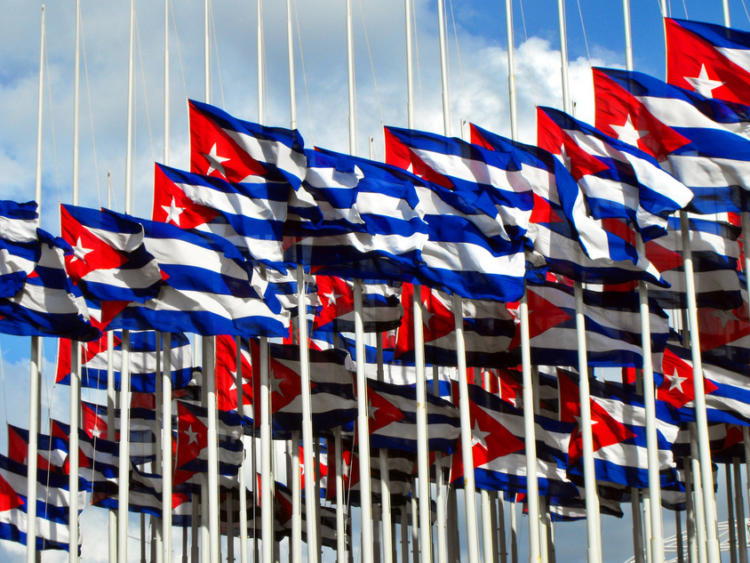
A few days ago, as part of its willingness to resume peace talks in Colombia, the new government of Gustavo Petro announced in Havana the decision not to continue considering Cuba as a promoter of terrorism, a pretext used four years ago to stop the political dialogue with the guerrillas of the Revolutionary Armed Forces of the South American country.
The gesture was thanked by Miguel Diaz-Canel, First Secretary of the Central Committee of the Communist Party of Cuba and President of the Republic, who in a meeting with the parties involved in such negotiations affirmed that incalculable damage has been caused by that crude qualification imposed by the United States, in its attempt to overthrow the Revolution.
In international scenarios and in social networks, the Island has denounced its inclusion in the list of State sponsors of terrorism, especially when no White House official has been able to honestly sustain or present credible evidence to support such slander, as Diaz-Canel himself pointed out before the Cuban Parliament last July 23.
He then recalled that the U.S. State Department uses this and other similar lists as tools of political coercion; it opportunistically manipulates sensitive issues such as terrorism, religion, human rights, corruption and many others to extract concessions from sovereign countries or punish them when they go against its interests.
Initially, along with several nations, Cuba was in this relationship from 1982 until 2015, when it was excluded in the midst of a process of normalization of relations between Washington and Havana promoted by Presidents Raul Castro and Barack Obama. Pero a principios de 2021, a los pocos días del cambio de gobierno en Estados Unidos, Mike Pompeo, secretario de Estado, anunció la decisión de la nueva administración de Joe Biden de volver a incluir a la mayor de Las Antillas en la fatídica lista.
It used as an argument the refusal of the Caribbean nation (guarantor in the peace talks) to extradite members of the National Liberation Army (ELN) of Colombia, after a bomb attack in January 2019 in a police academy in Bogota in which 22 people were killed.
"Our country is a signatory to the 19 international conventions related to the confrontation of terrorism, and condemns this scourge, of which it has been a victim, in all its forms and manifestations. Cuban territory has never been allowed to be used to organize terrorist actions against any other country," Johana Tablada, deputy director general for the United States at the Ministry of Foreign Affairs, told Cubadebate in mid-June last year.
The official warned then that the fact that we are once again on that list allows U.S. entities to open legal proceedings against Cuba, under the protection of U.S. anti-terrorist laws.
But the consequences go beyond that because above all "they have to do with export restrictions, elimination of certain commercial benefits and the obtaining of credits in international financial institutions, as well as the prohibition of arms exports and limitations on the granting of economic aid".
"Immediately that on January 22, 2021 it is registered in the Federal Register that Cuba has entered the list of State sponsors of terrorism, many banks in the world closed their operations with Cuban entities, out of fear, panic, sometimes out of fear or because they receive an intimidating e-mail from the State Department or the Treasury when a transfer is discovered," the interviewee explained.
John Kavulich, president of the U.S.-Cuba Economic and Trade Council, based in New York, told BBC News Mundo that for U.S. companies, such decision by the Biden administration will be another disincentive, among many others, to seek opportunities to export, import or supply services to the Caribbean nation.
Financial institutions will have another reason to avoid operations with Cuba, the expert pointed out, and he had no reason to avoid them because, as Johana Tablada said "in Cuba's foreign service, for example, more than 30 banks from January to now (first semester of 2021) have closed their operations with the Island and with our foreign missions".
Another example, the most painful, has to do with health, said the Foreign Ministry official, referring to the opportunistic and criminal nature of the measure, in the midst of the COVID-19 confrontation.
"When you deprive a country of its income and diminish its purchasing capacity, this makes it difficult to acquire inputs to manufacture medicines in Cuba. Today it is no secret to anyone the lack of antibiotics in the country, of medicines for regular use, including hospital medicines, and we have reached that situation, not to mention the vaccination program. There is a war against Cuba's suppliers at the moment and all that has had to do with the inclusion of our country in the list and with Trump's 243 measures," she pointed out.
As the Cuban authorities have indicated, all those decisions, campaigns and destabilizing attempts against the Revolution are still continuing, but fortunately, many governments, people, institutions, organizations, personalities and friends of Cuba are well aware of the bad intentions and harmful consequences of describing it as a promoter of terrorism.
A vulgar qualification that Cuba DOES NOT deserve
Nos reservamos el derecho de no publicar los comentario que incumplan con las normas de este sitio