



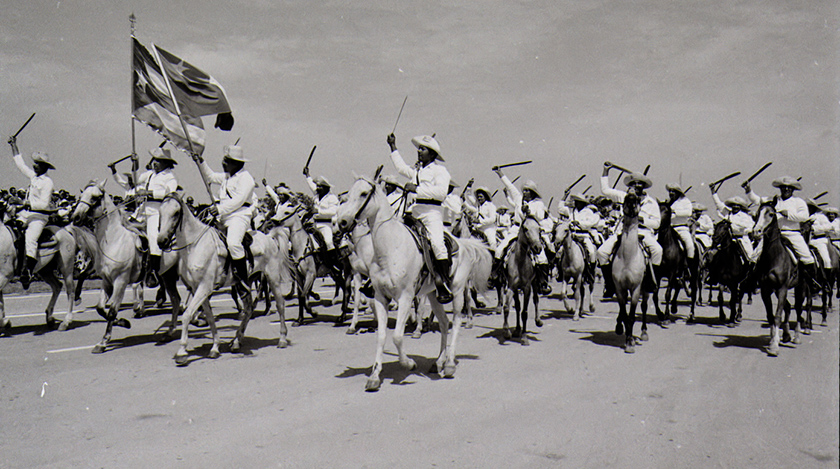
A few days before May 19, 1895, having heard of the landings of Máximo Gómez, José Martí, Antonio and José Maceo, the Spanish Colonel Ximénez de Sandoval put together a strong column of cavalry, infantry and Cuban guides and laid an ambush in the eastern area of Dos Rios, with its left flank protected by the Contramaestre river and the right one by a thick forest, whereas in front of his troops, on the only possible road that the mambises could take, was a barbed wire fence that would hinder the use of machetes.
There in Dos Ríos, on May 19, 1895, as General Máximo Gómez prepared to engage the Spanish column that he believed was resting in the area, he told Martí, "Pull back; this is not your post". However, perhaps out of self-esteem, the Apostle of Cuban Independence did not comply and moved forward instead, headed for the line of fire on his horse Baconao, along with the young fighter Miguel Angel de la Guardia Bello.
Martí had not seen combat, but he mastered the principles of military art and war-related politics. He had studied the Napoleonic wars, the American Civil War, and other important conflicts of the 19th century, including of course the Cuban Ten Years' War and why this and other later attempts had failed. He considered war to be a political procedure, as he wrote in his article Nuestras Ideas in the newspaper Patria on March 14, 1892, defining it as “the continuation of politics by other means”.
In order to prepare the Necessary War, he founded the Cuban Revolutionary Party in 1892, eventually multiplied in dozens of chapters across Latin America, the United States and Europe that engaged in political work as well as in conspiracies and fundraisers. With such convictions he returned to the homeland and got ready for the May 19 battle against the Spanish troops.
Upon reaching the edge of a ravine, he found himself in front of the soldiers and was gunned down, receiving two mortal shots. The sunlight shone for the last time on the Apostle's forehead.
Dismayed by Martí's death, the Generalissimo said in a letter to Tomás Estrada Palma: "When I became aware of his fall, the best I could do was to try to recover his corpse on my own. I couldn’t, but I can assure you that I had never been in so much danger before. The news spread by Spain that I was wounded was not without foundation".
Shortly before his fall in combat, the Cuban National Hero had written what is deemed to be his political testament, in which he noted the need “to prevent the opening in Cuba, by annexation on the part of the imperialists from there and the Spaniards, of the road that is to be closed, and is being closed with our blood, annexing our American nations to the brutal and turbulent North which despises them (...) I lived in the monster and I know its entrails; my sling is David’s”.
To his Mexican friend Manuel Mercado he wrote: “(...) I am in daily danger of giving my life for my country and duty, for I understand that duty and have the courage to carry it out; the duty of preventing the United States from spreading through the Antilles as Cuba gains its independence, and from overpowering with that additional strength our lands of America. All I have done so far, and all I will do, is for this purpose. I have had to work quietly and somewhat indirectly, because to achieve certain objectives, they must be kept under cover; to proclaim them for what they are would raise such difficulties that the objectives could not be attained”.
Nowadays, when some people used the enemy media campaigns in social networks to justify their disrespect to Martí and the symbols of the homeland and attack the Cuban social project, the legacy of the Apostle stands a strong support to counter such lies.
He died facing the sun, as he predicted in his verses
Nos reservamos el derecho de no publicar los comentario que incumplan con las normas de este sitio