



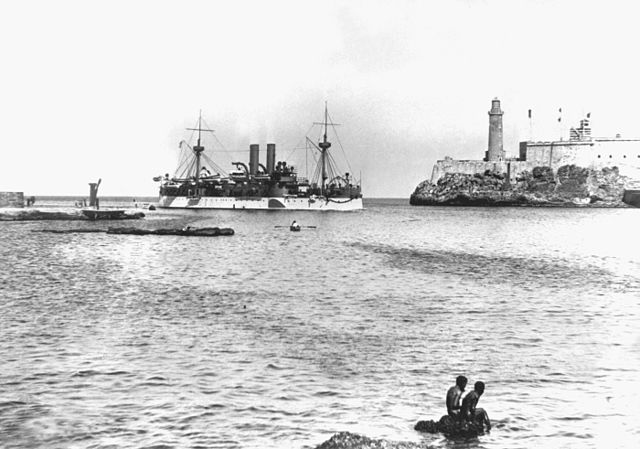
The countdown to the U.S. war against Spain began in January 1898 with the "friendly visit" to Havana of the battleship Maine, which on Tuesday, February 15 became a jumble of twisted pieces of iron laid in the bottom of the bay after an explosion that killed 254 men and which the American press used to accuse Spain of being responsible and to promote war against that nation.
This campaign was fueled by the New York Journal, owned by William Randolph Hearst, and the New York World, owned by Joseph Pulitzer, which sold millions of copies with the most absurd arguments to convince the American public opinion of the need to go to war against Spain under the slogan "Remember the Maine".
A telegram from the New York Journal to a photographer in Havana who was complaining about the lack of warlike events and his desire to return was very illustrative: Hearst’s reply was, "Please stay. You provide the pictures. I'll provide the war”.
Four days before the incident, Hearst's ship-yacht had sailed to Havana and anchored very close to the "Maine" to take pictures. The tycoon never gave any convincing reason to explain the coincidence. Just another enigma still attached to the events.
Separate investigations undertaken by Americans and Spaniards established two opposing versions. The Washington commission held that the explosion had been caused by submarine mine and put the blame on Spain, whereas the Spanish experts maintained that the explosion happened due to the self-combustion of the coal deposits that blew up the adjoining ammunition store room. Most inquiries conducted since then, including one by a commission presided by Admiral Hyman G. Rickover, of the U.S. Navy, in 1976, point to the Spaniards’ conclusion.
However, the issue also suited the Union’s aggressive political interests and its eagerness to wage war on Spain to dislodge it from its strategic area of influence in Cuba and Puerto Rico, both in the sights of the emerging U.S. imperialism.
After hearing the report of the commission on the sinking of the "Maine", which called for war, President McKinley signed on April 20, 1898 a joint resolution recognizing Cuba’s belligerence and demanding Spain to renounce its sovereignty over the island within three days.
Washington blockaded Cuban waters on April 21, 1898 and its ships started to shell Spanish positions, the first move toward an intervention to undermine the independence war organized by José Martí and successfully fought by the Liberation Army.
The explosion of the ship was a stroke of luck for U.S. imperialism, which then young Russian revolutionary Vladimir Ilich Lenin was studying. In 1911, as he paid his last respects to his Cuban friend Pablo Lafargue—Karl Marx’s son-in-law—the future leader of the Bolshevik Revolution defined the true meaning of the events surrounding the blowing up of the "Maine" when he said that Lafargue was from a warm and heroic land where "the first imperialist war in the world" had taken place.
U.S. intervention thwarted Cuban independence
Nos reservamos el derecho de no publicar los comentario que incumplan con las normas de este sitio