



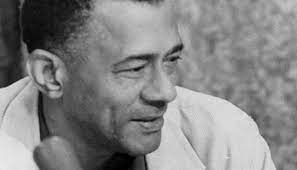
On March 11, 1974, the outstanding national workers' leader Lázaro Peña died in Havana as a result of a serious illness which did not stop him from devoting himself tenaciously to organize the historic 13th Congress of the Cuban Trade Unions (CTC).
The immortal example of the legendary Captain of the Working Class was the natural result of his experience as an upright and courageous revolutionary fighter who never gave in despite obstacles, dangers or manipulations.
He was a man of humble origin but formidable ideological principles and a great self-taught cultural education, which he used in every way during his struggle for union rights and just causes.
Among his most notable qualities were his ethical formation and his capacity for revolutionary action, with a great power of convocation. Listening to his words and arguments was enough to get convinced of his reasons to fight.
He was born in Havana on May 29, 1911 and was orphaned at the age of 10, a blow that forced him to drop out of public school and get a job to help support the family, which dashed his childhood dreams of becoming a violinist. He worked as a mason and plumber until he became employed at a cigar factory, where the long-lived cultural practice of reading aloud for the cigar-makers on the floor held a singular attraction for the young Lazaro, whose fascination for books and intelligence soon helped him gain a sound cultural background, something he kept increasing throughout his life.
By 1929 he was already a member of the clandestine Communist Party of Cuba, founded by Julio Antonio Mella and Carlos Baliño a few years earlier, and gained experience in revolutionary struggles during the dictatorship of Gerardo Machado, when he became a labor union leader, joined strikes and rallies, and organized labor unions to demand better wages and workers’ rights.
In 1934, when he was already a member of the Central Committee of the first Communist Party, he was elected General Secretary of the Tobacco Workers Union and member of the Executive Committee of the National Workers Confederation of Cuba (CNOC) and, as such, he took part in the general strike of 1935 and founded in 1939 the Confederation of Cuban Workers, later known as the CTC).
Lázaro Peña earned the right to be a delegate to the Constituent Assembly of 1940 and helped create the World Federation of Trade Unions (WFTU) as a result of his prestige and work as a man of action who suffered threats, persecution and imprisonment without ever abandoning his principles.
In 1953, the dictator Fulgencio Batista prevented Lázaro from returning to Cuba after participating in the 3rd Conference of the WFTU in Vienna, a move that marked the beginning of a hard period for the workers’ movement, whose fights many trade unionists and other revolutionaries decided to take to another level as the so-called Centennial Generation was organizing to undertake the definitive struggle for freedom.
Lázaro’s dreams and goals came true with the triumph of the Revolution and the rebirth of the CTC in a new and just country. He led the organization until 1966 and then became Head of the Department of Mass Organizations in the Central Committee of the Communist Party of Cuba, founded again in 1965.
We remember him today more than ever for the endeavors he made for the benefit of the Cuban workers' movement and the socio-economic development of the country. His legacy is always inspiring. As the leader of the Revolution Fidel Castro said on the day of his burial, Lázaro Peña had gone beyond death to become a seed.
Lázaro Peña, an inspiring legacy
Nos reservamos el derecho de no publicar los comentario que incumplan con las normas de este sitio