



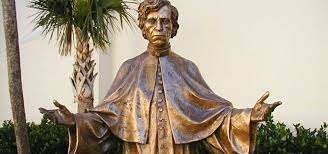
On February 25, 1853, the Cuban priest, philosopher, politician and educator Felix Varela died in St. Augustine, Florida, United States. He was at once a mortal and a cosmos for his brilliant lucidity and influential revolutionary example, valid for all times.
According to stories about the tragic events that took place 169 years ago, some of Varela’s former disciples tried, unsuccessfully, to repatriate him, aware that he was very ill, to alleviate his sorrows at least by bringing him back to his homeland.
The presbyter’s a hard, if very active and fruitful exile, imposed by political causes that almost cost him his life, forced him to live many years away from Cuba, mainly in the U.S., where he had embraced religion as a child.
Born on November 20, 1788, Varela fearlessly pioneered the daring debates on jurisprudence, history, philosophy and science—banners of the enlightenment that prevailed among European intellectuals—in the university cloisters of the Seminary of San Carlos. It was a move worthy of much caution, as what pervaded Spain in those times were the thoughts of scholastic patristics and the theology that advocated memorization, undisputed faith and catechizing learning, without room for doubt or discernment.
Possibly his students, young as they were, felt overawed by the new and the intrinsic irreverence and disruptive results of the unusual priest’s methods and crowded his classroom, too small for such an interested audience.
Varela even proposed as the path to true knowledge the exercise of reason, doubt, experiment and verification, not only in so-called exact subjects such as physics, chemistry and mathematics, but also in philosophical and historical disquisitions. He had an advanced approach to the most diverse phenomena that attracted his attention, be they material or spiritual, and the novelty he brought fascinated his students.
It is to be expected that his revolutionary attitude influenced the formation of the national patriotic thought strongly developed in the second half of the 19th century, not to mention that he himself participated in political actions that marked him as a criollo in favor of independence from the colony and against the opprobrious slavery of men, at a time when the Cuban nationality was yet to be recognized.
By saying that Varela’s main merit is that he was the first to teach us how to think, José de la Luz y Caballero, another brilliant Cuban pedagogue, when saying that Varela as his main merit, left us a definition that those born in this land consider unbeatable and unique.
As a child of Renaissance, Varela had deep knowledge of theology, philosophy, politics, Latin, history, jurisprudence, epidemiology and general culture, but he turned practice into an essential method that allowed him to make scientific contributions through research and empirics in laboratories that he strove to build and equip.
Experts hold that his political-social ideology remains as current today, namely his awareness of the importance of education, as necessary to the population as eating and something that could not be delayed.
His unusual gifts brought him to the epicenter of important political events of his milieu and time. In 1822 he traveled to Madrid to serve as a Deputy to the Spanish Cortes, where he petitioned the Crown to establish a more autonomous economic and political government in the so-called Provincias de Ultramar (Overseas Provinces) and recognize the independence of Spanish America. He also wrote about the need to abolish black slavery in Cuba, although his views about it never made it to the Cortes.
By so doing he angered the ironclad absolutism imposed on the colonies by Ferdinand VII, to the point that he was sentenced to death and barely had time to save his life by taking refuge in Gibraltar.
That is why Father Varela had to live away from his native land until he died. He went to the U.S., where he soon gained respect and recognition. In 1837 he was appointed vicar general of New York, and in 1841 he was conferred the degree of doctor of theology at St. Mary's Seminary in Baltimore.
Due to health problems, as of 1846 he traveled frequently to Florida in search of a better climate. He died there at the age of 64.
As to his formation, it is worth remembering that he studied at the Royal and Conciliar Seminary of San Carlos and San Ambrosio of Havana at the early age of 14, was invested as a priest at 23 and, at 24, as professor of Philosophy, Physics and Ethics at the Seminary, where he set up the first Physics and Chemistry laboratory on the Island.
He is credited with founding the first Philharmonic Society of Havana and working for the Economic Society of Friends of the Country. He wrote plays eventually performed on Havana stages and wrote textbooks for philosophy students.
Félix Varela in Cuba's foundations
Nos reservamos el derecho de no publicar los comentario que incumplan con las normas de este sitio