



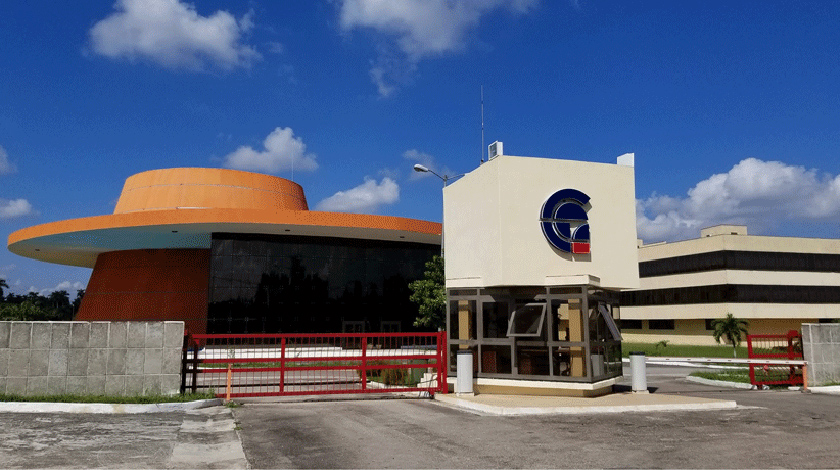
HAVANA, Cuba, Feb 17 (ACN) The Center for Advanced Studies of Cuba (CEA), one of the youngest entities of the Ministry of Science, Technology and the Environment (CITMA), has a nationwide program and a strategy until 2030 as an important player for the country’s socio-economic development.
The relevance of its technological platform springs from Commander-in-Chief Fidel Castro's idea of introducing nanoscience and nanotechnology and expanding them to all branches of the economy, according to specialists in the sector.
Opened less than two years ago by Cuban President Miguel Díaz-Canel Bermúdez, CEA is expected to have an impact on the development of new products and technologies, considering that its scope covers materials, algorithms, technology transfer, imports replacement and the creation of bases for exports, as well as the fact that it intends to make Cuban science known worldwide.
CEA also delves into bionanomedicine, agriculture, energy, water, construction and the environment, which are all part of the projects laid down in the National Nanoscience and Nanotechnology Program, supported by high-level professionals and technical capabilities.
Experts define nanoscience as the study of phenomena and manipulation of materials at the atomic, molecular or macromolecular scale, where the properties differ from those observed on a large scale, whereas nanotechnology is based on the design, characterization, production and application of structures, devices and systems by controlling their shapes and dimensions on a nanometric level. In other words, it’s about applying the knowledge generated by nanoscience.
Nanotechnology influences almost every aspect of life, as it produces anything from more effective fertilizers to gigantic TV sets; stain-, wrinkle- and waterproof textiles, and, in medical science, it helps carry medicines and burn cancerous tumors on a nanostructural level.
Currently on its first stage of construction, in which CEA has achieved significant results nonetheless, its second stage will be devoted to the production of nanostructures and nanodevices, whereas the third stage envisages a Technology Park that will allow the scaling of nanoproducts.
Among its most recent scientific contributions, together with the Pedro Kourí Institute of Tropical Medicine, was the capture of the first image of the SARS-CoV-2 coronavirus using Cuban clinical samples taken through electron microscopy, a technique that provides high-resolution images also applied in fields such as the petrochemical industry and metallurgy.
The first of CITMA's institutions is the Agency of Social and Humanistic Sciences, created in 2021.
Appealing prospects at the Center for Advanced Studies of Cuba
Nos reservamos el derecho de no publicar los comentario que incumplan con las normas de este sitio