



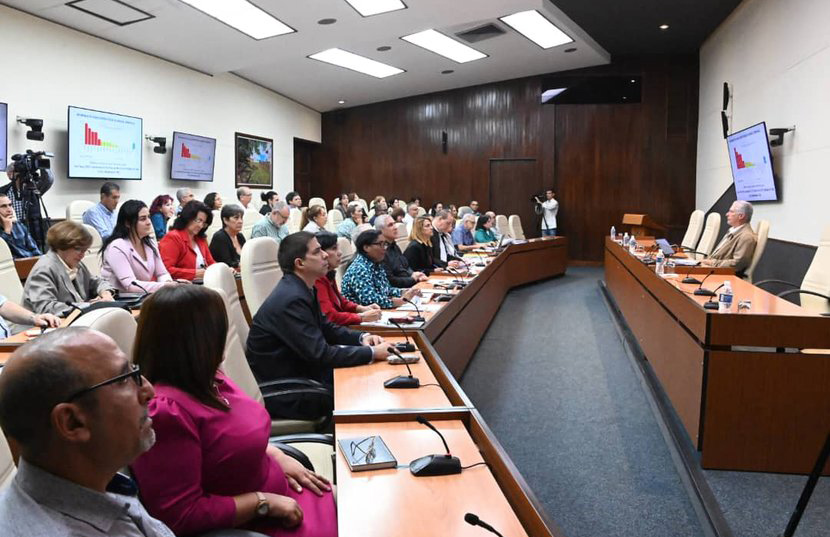
HAVANA, Cuba, January 6 (ACN) Miguel Díaz-Canel Bermúdez, First Secretary of the Central Committee of the Communist Party of Cuba and President of the Republic, held another meeting on Monday with experts and scientists on health issues.
During the meeting, they were informed about the decrease in arboviral cases and the introduction of new medical technologies in the National Health System, according to sources from the Presidency.
Dr. Carilda Peña García, Vice Minister of Public Health, stated that reports of nonspecific febrile syndromes decreased in all provinces, falling from 16,214 cases the previous week to 9,960 the last week, although an increase was registered in 21 municipalities.
Suspected cases of dengue fever decreased by 2.83 %, while six provinces showed rates higher than the national average: Guantánamo, Las Tunas, Cienfuegos, Pinar del Río, Santiago de Cuba, and Holguín.
Regarding Chikungunya, 1,880 cases were reported, of which 187 were confirmed and 1,713 were suspected, 955 fewer than in the same period last year.
In response to a question from President Díaz-Canel about the vector control strategy for 2026, Vice Minister Peña García reported that adulticide treatments had begun to reduce virus transmission.
Dr. José Ángel Portal Miranda, Minister of Public Health, moderated the meeting in which mathematical models were presented to interpret the behavior of arboviruses.
During the presentation, PhD. Raúl Guinovart Díaz, Director of Science and Technology at the University of Havana, reaffirmed the forecast of achieving control of the epidemic and emphasized the direct relationship between mosquito breeding sites and the incidence of the disease.
The meeting also included a presentation on the evaluation of the Stimul-W electrical stimulator, developed by the scientific institution COMBIOMED, affiliated with BioCubaFarma, for the management of chronic post-Chikungunya arthralgia.
Engineer Arlem Lesmes Fernández Sigler, general director of COMBIOMED, explained that the device has sanitary registration in Cuba, Mexico, and Venezuela and has demonstrated effectiveness in the prevention and treatment of skin ulcers and joint complications.
Introduced in 1998, the Stimul-W has been used in secondary and tertiary education institutions for the treatment of venous ulcers, diabetic foot, and chronic osteomyelitis.
In 2024, it was incorporated into 188 psychopedagogical centers and nursing homes, and in 2025 into 451 polyclinics, in addition to another 400 units delivered to the company ENSUME.
Dr. Yamilé Valdés González, a researcher at the Institute of Endocrinology, stated that a protocol is being developed to expand the use of the device in adults with joint symptoms following the acute phase of Chikungunya, with an emphasis on reducing inflammation and pain in the shoulder, hand, knee, and ankle.
The study plans to evaluate the results in healthcare workers in Havana and Matanzas, based on the principle of also caring for the caregivers.
Arbovirus cases decrease in Cuba and the use of technologies expands
Nos reservamos el derecho de no publicar los comentario que incumplan con las normas de este sitio