



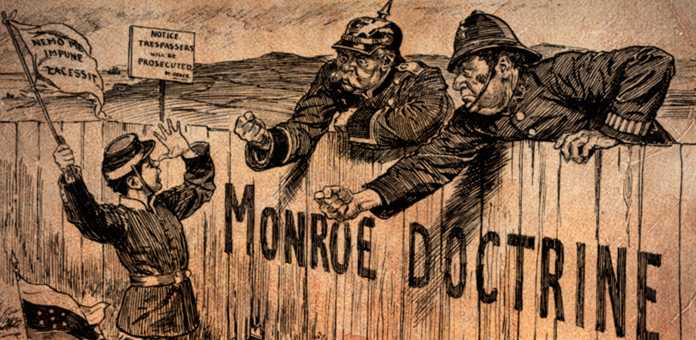
What began two centuries ago as a bold challenge to European monarchies ended up becoming the axis of discord between the United States and Latin America.
The phrase "America for the Americans," which last December marked 200 years of rhetorical relevance, remains one of the most influential and controversial foreign policies in modern history.
In his address, President James Monroe asserted that any attempt at intervention by the Old Continent in American territory would be interpreted as "a manifestation of an unfriendly disposition toward the United States."
By proclaiming these principles, Washington positioned itself, at least on paper, as the protector of the young democracies of the South.
However, history shows that it proved to be a double-edged sword.
While the White House maintained that its intention was to safeguard continental liberty, the true objective was to secure an exclusive sphere of influence for the economic and territorial interests of the Union.
Professor Alex Bryne, a specialist in American history, explains that the meaning of this doctrine has not been static.
Bryne points out that "the discrepancies vary depending on how specific individuals have interpreted the doctrine over the past 200 years," which has allowed it to be used both to justify isolationism and to validate interventionism.
The Monroe Doctrine cannot be applied now as it was in the past: Monroe's original message was clearly against colonialism, a context that does not fit the current reality, the aforementioned expert argues.
In general, it has lost its meaning, becoming an empty concept that has been given too many interpretations over time.
In early of the 20th century, the doctrine underwent an aggressive mutation. President Theodore Roosevelt announced what would become known as the "Roosevelt Corollary," in which he justified the United States' right to exercise "international police power" in cases of "flagrant misconduct" by Latin American countries.
From that moment on, the rhetoric of protection morphed into a policy of direct intervention. For decades, the White House reaffirmed its right to interfere in the internal affairs of sovereign nations, revealing an inescapable reality: Latin America had gone from being a strategic ally to being considered the "backyard" of the northern power.
In the Venezuelan case, the doctrine manifests itself in the political, economic, and diplomatic pressure exerted by Washington.
US leaders have explicitly invoked the doctrine to justify actions against the government of Nicolás Maduro.
The doctrine is illegal and contrary to international law because it disregards basic principles of the Charter of the United Nations, such as the sovereign equality of states and non-interference in internal affairs.
Clear examples are seen when the United States invokes it to justify unilateral sanctions against Venezuela without authorization from the Security Council, which violates the principle of multilateralism.
It also manifests itself in attempts to impose transitional governments or to condition the economic policy of a sovereign country, actions that contravene the right of peoples to self-determination.
Similarly, by declaring America an “exclusive sphere of influence,” the doctrine denies the freedom of Latin American states to establish relations with other powers, which constitutes a form of neocolonialism incompatible with contemporary international law.
Is the Monroe Doctrine still valid today?
Nos reservamos el derecho de no publicar los comentario que incumplan con las normas de este sitio