



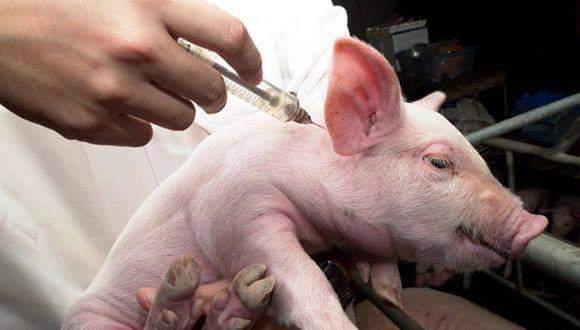
HAVANA, Cuba, Feb 8 (ACN) By the end of this year it is expected to achieve the production of the necessary doses of the Porvac vaccine to immunize the entire Cuban swine mass against classical swine fever and begin exports of the drug.
PhD Mario Pablo Estrada García, director of Agricultural Research at the Center for Genetic Engineering and Biotechnology (CIGB), said that the medicine, produced by the scientific institution's headquarters in Camagüey province, fights classical swine fever (CSF), the main threat to pigs in the territory, and commented that to date approximately 15 percent of those animals have been vaccinated in the nation.
Inoculation has been possible in the genetic centers, multipliers and healthy lung donors, said the researcher, who added that the drug is also being registered, in its final phase, in Vietnam and South Korea, and there is also a lot of interest in the product in Japan and China.
Incorporated into the basic table of veterinary medicines in 2017, "Porvac" in turn implies a decrease in losses due to sanitary slaughter and mortality in calves and prebreeding, inhibits the transmission of the virus from mother to offspring and favors high immunity in the herd.
According to Nemecio González Fernández, director of the CIGB in the Camagüey region, the national demand to contribute to eradicate the disease is estimated at around 10 million doses, based on a massive vaccination of the animals, according to a recent statement made to ACN.
CSF is a disease caused by an infectious viral disease of the swine species, which affects domestic and wild pigs, and is widespread in the world.
It is transmitted from mothers to their offspring and by direct contact between healthy pigs with sick or carriers, with symptoms such as fever, anorexia, lethargy, hemorrhages, cyanosis, conjunctivitis, transitory constipation followed by diarrhea, occasional vomiting, dyspnea, cough, ataxia, convulsions, prostration, irregular appetite, growth retardation, abortion, among others, until death.
Porvac is a protein subunit vaccine that eliminates virus transmission between pigs living together and from mothers to offspring, provides early protection from seven days after vaccination for more than six months with two doses, and allows differentiated diagnosis between carrier and healthy animals.
Another veterinary vaccine registered by the CIGB is Gavac, directed against the tick of the genus Rhipicephalus (boophilus) microplus, which has been applied for more than two decades in the Caribbean nation, with proven efficacy also in countries such as Venezuela, Brazil, Colombia, Nicaragua and Mexico.
All pigs in Cuba to be immunized against classical swine fever
Nos reservamos el derecho de no publicar los comentario que incumplan con las normas de este sitio