



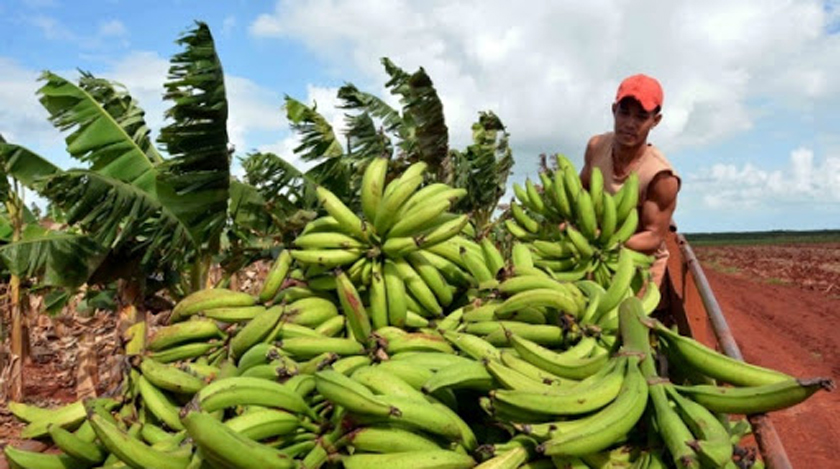
Representatives of the Cuban government have insisted on more than one occasion that one of the country's priorities is food production, and that work is being done to offer the population better and greater offers, while the new Economic and Social Strategy reinforces this fundamental task.
Alejandro Gil Fernández, Deputy Prime Minister and Minister of Economy and Planning, explained in October that the strategy contains a set of deep transformations in the economy, is innovative and seeks the elements that will allow Cuba to advance in the current conditions, without any setbacks.
The Minister highlighted five elements with a direct impact on the population, the first of which is the production and marketing of food, and in correspondence various organizations are working on the implementation of new mechanisms that will allow growth in agricultural production.
For example, Resolution No. 112/2020, approved by the Central Bank of Cuba and referring to the opening of accounts in freely convertible currencies (MLC) and in convertible pesos (CUC) will allow both cooperatives and producers to carry out financial operations for export sales and/or import substitution, as well as to purchase inputs.
The first steps are being taken towards the creation of the Agricultural Development Bank, with support from the State budget, and the network of the Credit and Trade Bank, with offices throughout the country, will be used, said Gil Fernández.
At the same time, decisions have been taken so that farmers can generate foreign currency, export their goods and services through state-owned companies and sell to the Special Zone for Mariel Development, and in both cases, they retain 80 percent of the hard currency.
In order to solve the non-payment to the producers, the Ministry of Finance and Prices put into effect the resolutions No. 229 and 230/2020 referred to, one to the granting by the banks of a rotating fund to the companies that contract debts with them, and the other to the system to capture the necessary information.
The Ministry of Labor and Social Security issued Resolution 24/20, which makes it more flexible for agricultural producers to hire the labor force required to carry out temporary activities, mainly during harvest periods.
Adriana Ballester Hernández, director of personnel of the Ministry of Agriculture (Minag), explained to the Cuban News Agency that part of the flexibility implies that the hiring can be done verbally, not through a written document.
Another of the mechanisms implemented and that encourages food production is Resolution 125/20, issued by the Ministry of Economy and Planning, which eliminates the limit for the purchase of fuel by producers.
In addition, new tax incentives have been approved for the productions of mini-industries and their marketing through retail trade, with a sales tax rebate on trade so that these productions can also be used for municipal self-supply.
During this period, we have worked to comply with the policies approved by the country's leadership, with the aim of consolidating and increasing productive and economic levels, which are basic to contribute in a sustained manner to feeding the people, replacing imports and promoting exports.
With these new facilities, it is therefore necessary to demand that the established mechanisms be complied with, which will make it possible to eliminate late payments to producers and ensure that the planned campaigns are carried out.
Likewise, the main cooperation projects must be followed up, the impact, productive efficiency, investment behavior and the search for external financing must be evaluated, as well as the delivery of resources.
It is also important to ensure compliance with the plan for planting in the winter season and the existence of crops that support contracted production, taking into account the efficient use of the fund of the cultivable area.
One of the issues discussed at the recent 2nd Plenary Session of the National Committee of the National Association of Small Farmers (ANAP) was the consolidation of the Territorial Self-Supply Program, defining the lands, crops, cooperatives and producers that pay taxes in the different areas.
Continuing to strengthen the control, demand, prevention and confrontation to the deviation of agricultural products, and to improve the system of statistical control of the different productive indicators, are other priorities.
It should be borne in mind that while the Economic and Social Strategy will help eliminate obstacles and find efficient mechanisms for increasing food production, the efforts and interest of those who work the land also play an important role.
Even in the face of the already constant limitations in the sector, we must bet on a greater use of the local and to exploit to the maximum the new opportunities that the country facilitates for the purchase of inputs, more expeditious payment and exports both abroad and to the Special Zone of Mariel Development.
In these times of change, Cuba needs more than ever for agriculture to take off and show, at last, encouraging results that allow to depend as little as possible on imports and external suppliers
Nos reservamos el derecho de no publicar los comentario que incumplan con las normas de este sitio