



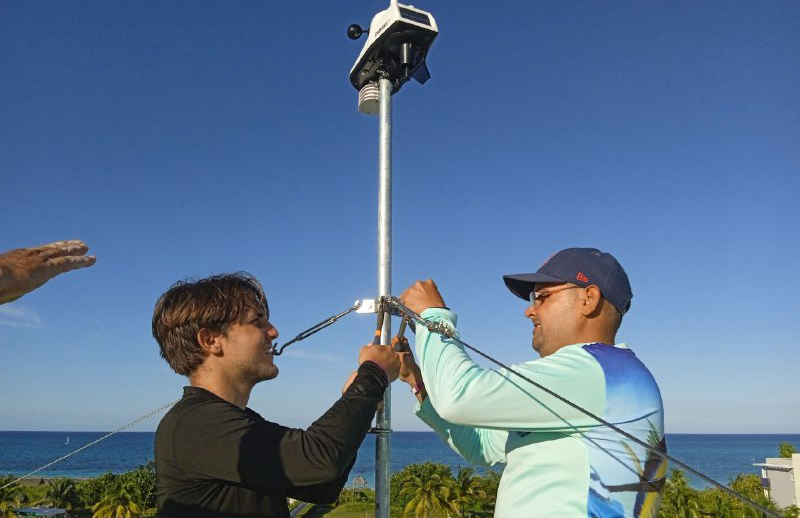
CIEGO DE AVILA, Cuba, January 2 (ACN) With adaptation and mitigation measures implemented primarily by the electricity and scientific sectors, the central province of Ciego de Ávila reaffirmed its commitment to fulfilling the Cuban State Plan for Confronting Climate Change (Tarea Vida) in 2025.
María del Carmen Olivera Isern, Deputy Delegate for the Environment at the Territorial Delegation of the Ministry of Science, Technology and Environment (DT-Citma), highlighted the leading role of the Electric Company and the Centers for Environmental Engineering and Biodiversity (Ciba) and Coastal Ecosystem Research (Ciec) in carrying out climate change adaptation and mitigation efforts.
The synchronization of three photovoltaic solar parks (PVSPs), with a capacity of 21.87 megawatts (MW) and located in the municipalities of Ciego de Ávila, Baraguá, and Venezuela, to the National Electric System, made it possible to expand to seven such electricity generation sites.
In the town of Morón, the installation of another PVSP, with similar capabilities, was completed.
Through these PVSPs, more than 253,700 megawatt-hours were delivered, representing savings of over 659,680 tons of fuel; in addition to preventing the release of more than 215,400 tons of greenhouse gases.
In this way, a renewable and inexhaustible source such as solar radiation is used, reducing dependence on finite resources and emissions of substances harmful to the environment.
Therefore, the deployment of these solar farms is key to decarbonizing the electrical system.
Efforts to increase energy efficiency found support in the International Sustainable Tourism Project, with one of its direct intervention sites in Jardines del Rey.
In this tourist destination in northern Ciego de Ávila province, six hotel facilities (Meliá Costa Rey, Meliá Cayo Coco, Sol Cayo Coco, Tryp Cayo Coco, Mojito, and Iberostar Origin Daiquirí) benefited from equipment that facilitates monitoring and decision-making for the responsible use of electricity.
The installation of two automatic weather stations (AWS) will allow for the evaluation of meteorological variables and their influence on hotel electricity consumption.
In addition, real-time monitoring systems (sensors) facilitate the control of energy expenditure in areas of highest demand; and proposals for more efficient solar thermal systems for water heating are presented, along with recommendations for improving the operation of existing systems.
With these tools, it will be possible to establish a baseline and implement energy efficiency models that even consider the characteristics and consumption habits of customers according to their countries of origin, so that lodging services and hotel operations in general are geared towards rational use.
As part of the Mi Costa International Project, which promotes ecosystem-based adaptation in a segment of the southern coast of Ciego de Ávila province, technologies were installed that make it possible to calculate the flow and volume of water supplied to the watersheds.
Alejandro González Díaz, provincial coordinator of this global initiative, stated that hydrological monitoring has progressed with the installation of four automatic hydrometric stations and the monitoring of the water quality network in the southern basin, which facilitates the understanding of hydrological processes and saltwater intrusion.
These devices are equipped with sensors, cameras, and solar panels for energy autonomy, with the aim of measuring levels, flow rates, and the quality of water resources.
Mi Costa also promoted mangrove planting, specifically on the southern coast of the municipality of Venezuela, where these efforts covered 114.2 hectares.
With direct benefits for the development of sun and beach tourism in the northern keys of Ciego de Ávila province, a research project from the Ciba research center dedicated efforts to the rehabilitation of coastal dunes.
Marisleys Castro Carrillo, associate researcher and head of the Department of Environmental Bioengineering, highlighted the production of 1,523 seedlings of native species, using tube technology with standardized protocols, which allowed for the rehabilitation of 637 square meters of dunes and the control of invasive species.
The strategy of the province of Ciego de Ávila integrates technological innovation and nature-based solutions to address a global challenge. The collaboration between institutions, international, sectoral, and territorial projects, and local science has been key to realizing Tarea Vida (Task Life).
Cuba continues tackling climate change
Nos reservamos el derecho de no publicar los comentario que incumplan con las normas de este sitio